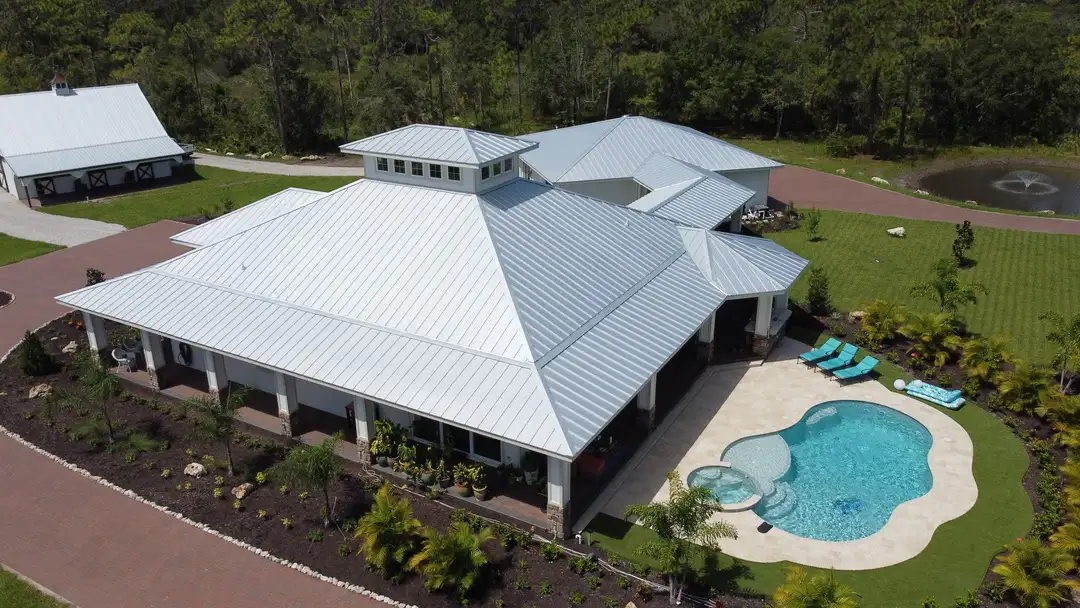
Living here in Southwest Florida, we tend to think of metal roofing as a modern solution to a modern problem. When we look up at a gleaming new Key West-style roof in Sarasota or Bradenton, we see it through the lens of hurricane protection and energy efficiency. It feels like high-tech armor against our specific blend of salt, sun, and storms.
But metal roofing isn’t a new invention. It isn’t even a 20th-century invention.
The truth is, if you choose a metal roof for your home, you are participating in a lineage that goes back thousands of years. The history of metal roofing is a story of democratization, evolving from a luxury reserved for ancient temples to a mass-market commodity that helped settle the American frontier, and finally arriving as the hurricane-resistant system we use today.
Here is how we got from the copper domes of antiquity to the Galvalume steel of the modern SWFL home.
Ancient World: When Roofs Were Built for “Eternity”
Long before we had asphalt shingles or synthetic underlayments, ancient builders understood a simple truth: metal is the closest thing we have to a “forever” material.
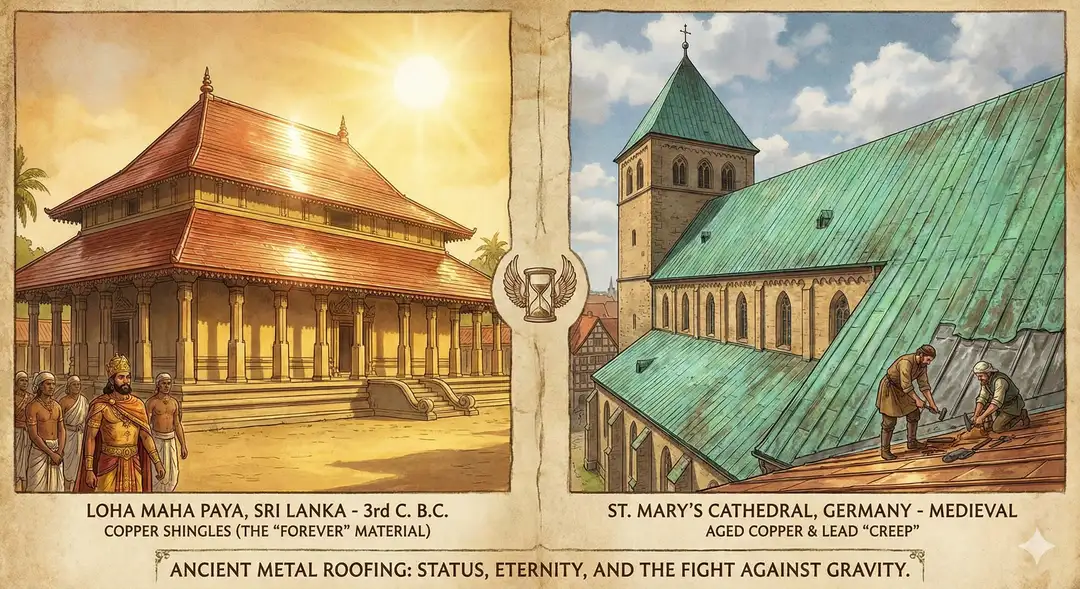
In the ancient world, metal roofing was the ultimate status symbol. It wasn’t about curb appeal; it was about immortality. The earliest recorded instance of metal roofing dates back to the 3rd century B.C. in Sri Lanka, where the Loha Maha Paya temple was crowned with copper shingles.
Why copper? As noted by Hoffmann Architects, copper develops a protective patina (that familiar green verdigris) that essentially heals the metal as it ages. This allowed structures like St. Mary’s Cathedral in Hildesheim, Germany, to maintain their original roofs for centuries.
However, this permanence came with a heavy price tag and technical challenges. In medieval Europe, builders also experimented with lead sheets. While incredibly durable, lead is heavy. The National Park Service’s Preservation Brief 4 documents a phenomenon known as “creep,” where massive lead sheets would slowly deform and slide down the roof slope due to gravity and thermal expansion.
For thousands of years, this was the reality: metal roofing was incredibly effective, but it was exclusively for the gods, kings, and the ultra-wealthy who could afford the artisan roof maintenance required to fight gravity.
The Industrial Revolution
If you were a settler moving West in the 1800s, you couldn’t bring a slate roof with you in a covered wagon. You needed something light, stackable, and tough.
Enter Henry Robinson Palmer.
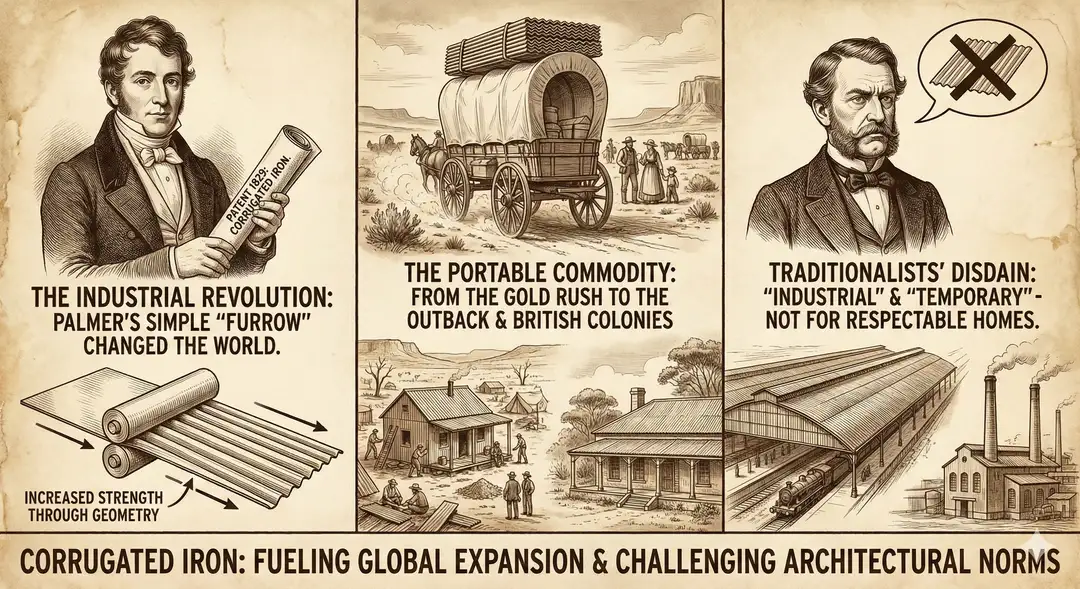
In 1829, Palmer, a civil engineer in London, filed a patent that would change the world of construction: corrugated iron.
Before this moment, iron sheets were flat and flimsy. To make them strong enough for a roof, they had to be thick and heavy. Palmer discovered that by simply putting a “furrow” (or ripple) in a thin sheet of iron, he could increase its strength exponentially.
According to research from Drawing Matter, this simple geometric trick allowed thin, lightweight metal to span wide spaces without needing heavy timber support. Suddenly, a roof wasn’t a heavy burden; it was a portable commodity.
This invention didn’t just change architecture; it fueled global expansion. The “corrugated iron” roof became the shelter of choice for the American Gold Rush, the Australian Outback, and British colonies in India. It was the first time in history that a durable, waterproof roof could be shipped in a crate and installed in a day.
However, it wasn’t always loved. As noted in the Building Conservation Directory, traditional architects initially hated corrugated iron. They saw it as “industrial” and “temporary,” suitable for train stations and factories but not for respectable homes. It would take American ingenuity to bring metal roofing into the residential neighborhood.
Thomas Jefferson and the “Tin” Roof
We often hear folks in the South refer to “an old tin roof.” While the phrase is charming, it’s usually a misnomer. Most of those old roofs were actually steel or iron. But the obsession with “tin” started with one of America’s most famous architects: Thomas Jefferson.
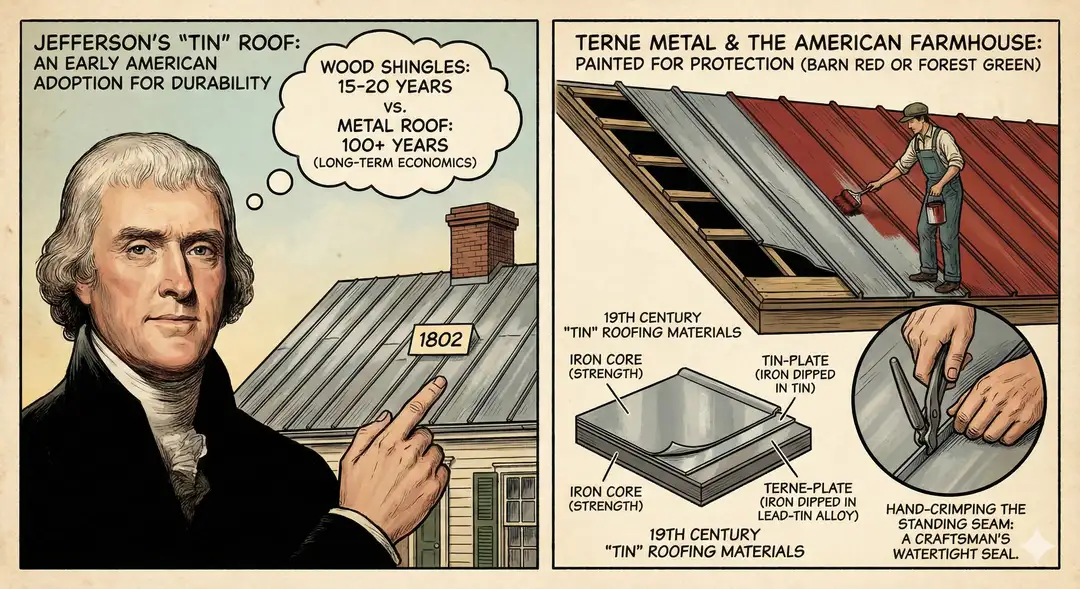
Jefferson was an early adopter of metal roofing in America. According to the Monticello Research Department, after observing metal roofs in Paris, Jefferson decided to install “tin shingles” on Monticello around 1802.
His reasoning was purely economic. He argued that while a wood shingle roof might need replacing every 15 to 20 years, a metal roof could last over a century. He viewed it as a long-term calculation, which is a perspective that many of our customers here in Florida still share today.
But what were these roofs actually made of?
In the 19th century, pure tin was too soft to use alone. Instead, manufacturers created “tin-plate” (iron dipped in tin) and eventually “terne-plate” (iron dipped in a lead-tin alloy).
As detailed in Metals in America’s Historic Buildings (US Dept. of Interior), terne metal became the standard for the American farmhouse. The lead-tin coating was dull and gray, which is why these roofs were almost always painted (usually that classic barn red or forest green) to add an extra layer of rust protection.
This was the golden age of the “standing seam” roof. Skilled craftsmen would hand-crimp the seams between these small metal plates, creating a watertight seal that could expand and contract with the heat. It was a beautiful, handcrafted system, but it still required regular painting to survive.
The Silver Lining: The Rise of Aluminum
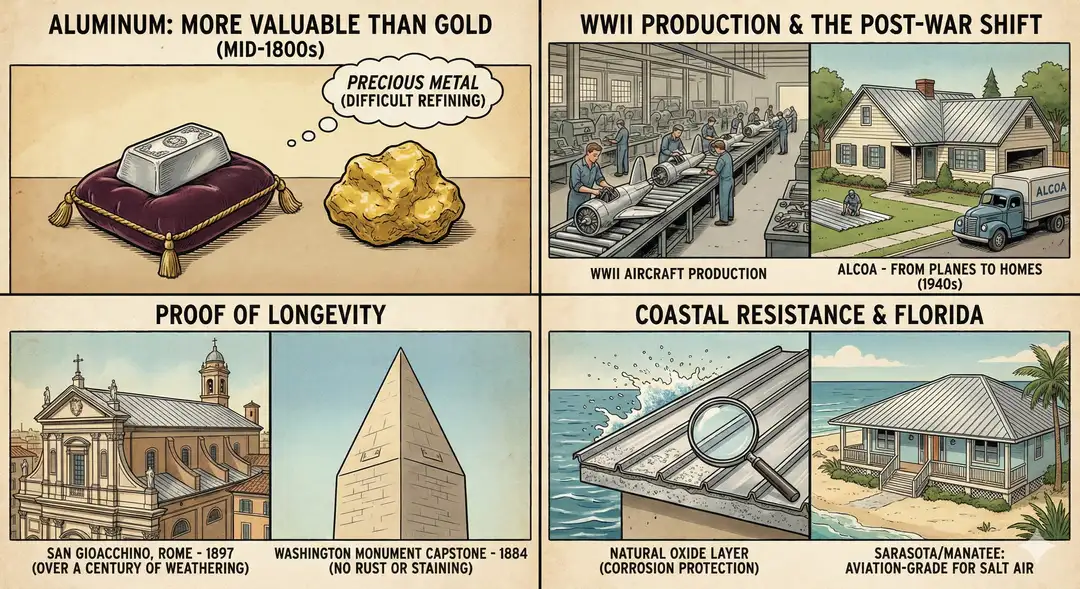
You might be surprised to hear that aluminum was once more valuable than gold. In the mid-1800s, it was considered a “precious metal” because refining it was so difficult.
But just as production methods improved, architects began eyeing this lightweight, silver metal for the ultimate challenge: the roof.
The proof of aluminum’s incredible longevity sits in Rome, atop the Church of San Gioacchino. Installed in 1897, this massive aluminum roof has weathered over a century of Italian summers and pollution without significant corrosion.
Closer to home, we have our own monument to aluminum’s durability. The capstone of the Washington Monument, set in 1884, is a 100-ounce pyramid of solid aluminum. At the time, it was the largest single piece of cast aluminum in the world, chosen specifically because it wouldn’t rust or stain the white stone below it.
However, the real turning point for residential aluminum roofing didn’t happen until the 1940s.
During World War II, aluminum production skyrocketed to build aircraft for the Allied forces. When the war ended, manufacturers like Alcoa suddenly had massive factories and no planes to build. They needed a new market, and they found it in the American home.
This shift was a game-changer for us here on the coast. Unlike steel, which requires heavy coatings to prevent “red rust,” aluminum naturally resists corrosion. When exposed to oxygen, it forms a thin, hard oxide layer that actually protects the metal from further damage.
For homeowners in Sarasota and Manatee counties, this is a critical piece of history. When you install an aluminum roof today, you are benefiting from aviation-grade technology that was battle-tested in the 1940s and proven to handle salt air better than almost anything else.
The Modern Era: Science Solves the Rust Problem
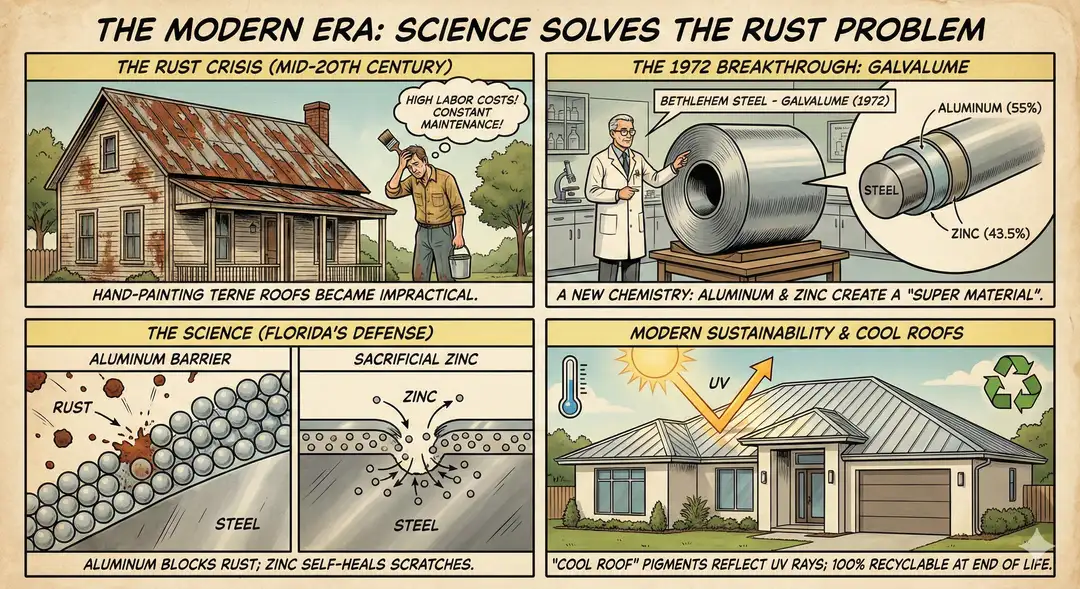
By the mid-20th century, the metal roofing industry faced a crisis. As labor costs rose, the idea of hand-painting a terne roof every few years became impractical. Homeowners wanted the durability of metal without the maintenance of an 1800s farmhouse.
The breakthrough happened in 1972.
Bethlehem Steel introduced a product called Galvalume. As documented by Sheffield Metals, this wasn’t just a new shape; it was a new chemistry. By coating steel in a precise mixture of aluminum (55%) and zinc (43.5%), they created a “super material.”
Here is why that specific mix matters for us in Florida:
- Aluminum acts as a barrier, preventing rust from ever touching the steel core.
- Zinc acts as a “sacrificial” layer, which means if the roof gets scratched by a falling branch, the zinc will actually migrate to cover the scratch and protect the steel.
This innovation brought us full circle. We returned to the longevity of the ancient copper roofs, lasting 50 years or more, but at a price point that made sense for the average homeowner.
Today, the “history of metal roofing” is still being written, but now the focus is on sustainability. The Metal Construction Association highlights how modern metal roofs are often coated with “cool roof” pigments that reflect UV rays, lowering cooling bills in our brutal summers. And at the end of its life, that steel is 100% recyclable, unlike asphalt shingles that end up in landfills.
Why This History Matters for Your Home
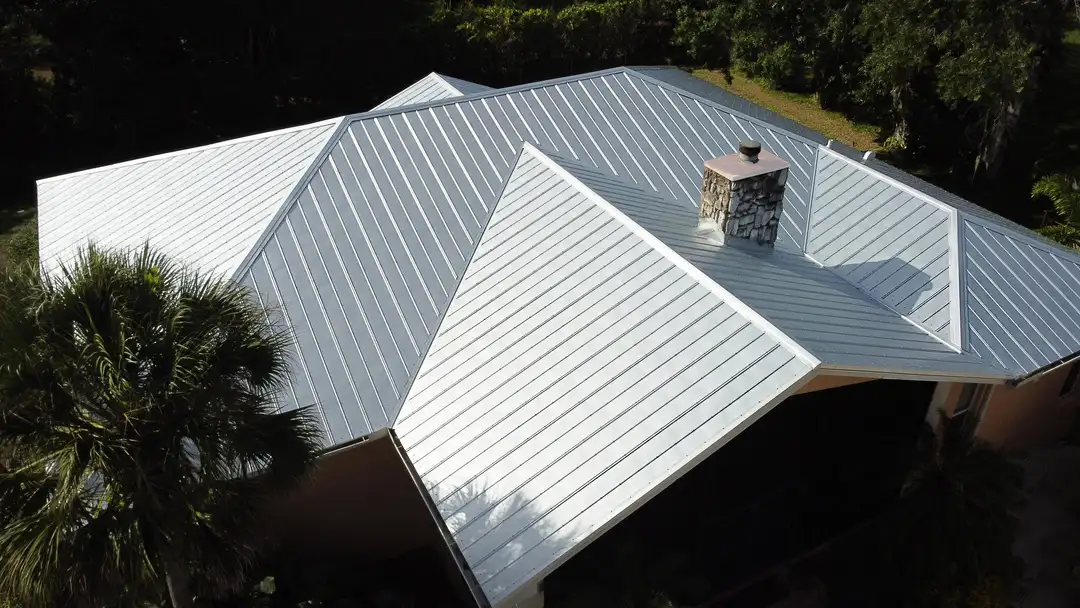
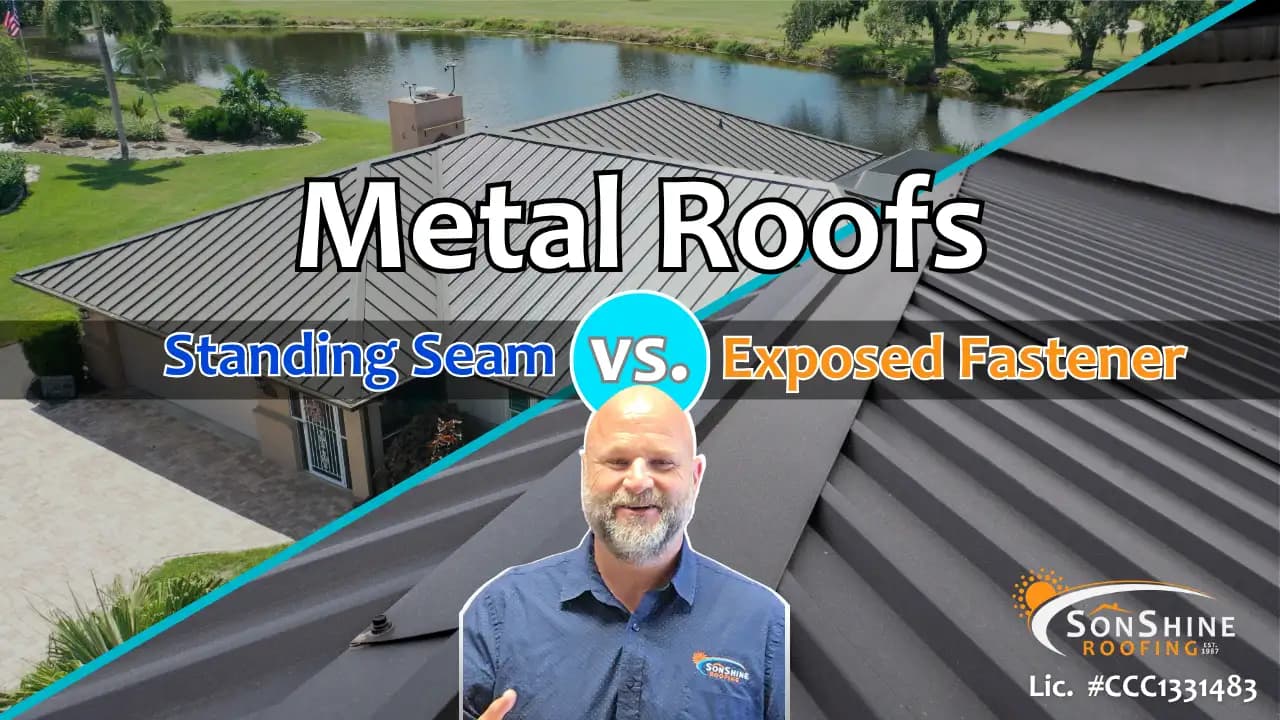
Knowing the history of metal roofing changes how you look at your own home. When you install a standing seam metal roof, you aren’t just buying a product off a shelf. You are leveraging:
- The permanence sought by ancient temple builders.
- The structural efficiency discovered during the Industrial Revolution.
- The chemical engineering of the modern era that fights off our salty, humid air.
We love this history because it proves that metal roofing isn’t a fad. It has survived for thousands of years because it adapts. It shifted from an art form to an industrial product, and finally to the high-performance building system we install today.
If you’re wondering if your current roof has enough history left in it to make it through the next hurricane season, give us a shout. We’re happy to come out, take a look, and give you an honest assessment.
Sources:
- Hoffmann Architects. (2017). Copper Roofing: The Original Green Roof.
- National Park Service. (1978). Preservation Brief 4: Roofing for Historic Buildings.
- Materia. Materia 2: Corrugated Iron. Drawing Matter.
- Building Conservation Directory. Corrugated Iron Architecture.
- Monticello Research Department. Roofing. Thomas Jefferson’s Monticello.
- Waite, J. G. (1992). Metals in America’s Historic Buildings. US Dept. of the Interior.
- Sheffield Metals. A Brief History of Standing Seam Metal Roofing.
- Metal Construction Association. (2018). The Life-Cycle Benefits of Metal Roofing.