In Southwest Florida, there’s no doubt about it: tile is king. Sure, asphalt shingles are the easy on the wallet, and standing seam metal systems are a worthy contender, but absolutely nothing beats tile for that classic Southwest Florida curb appeal. It stands up to our intense climate with ease while looking so darn good.
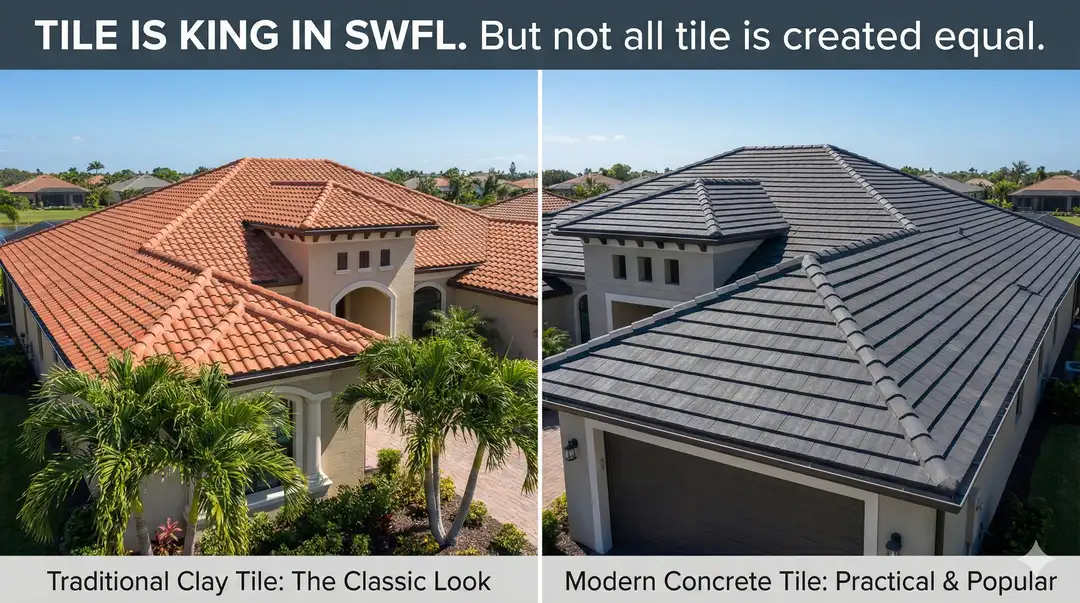
That being said, not all tile roofs are created equal. Traditionally, clay was the material of choice for those that could afford it. It is extremely durable, highly resistant to color fade, and heavy enough to withstand hurricane-force winds. But “traditional” doesn’t always align with “practical” for the modern homeowner.
In recent decades concrete has grown massively in popularity. Although its durability doesn’t quite measure up to the centuries-old lifespan of clay, it cleverly racks up small wins in other departments. It’s cheaper to produce, tougher against impact, easier to handle, and will still last well beyond the life of your mortgage if properly maintained.
Manufacturing Process
To best compare these two types of tiles, we must first understand how they are made.
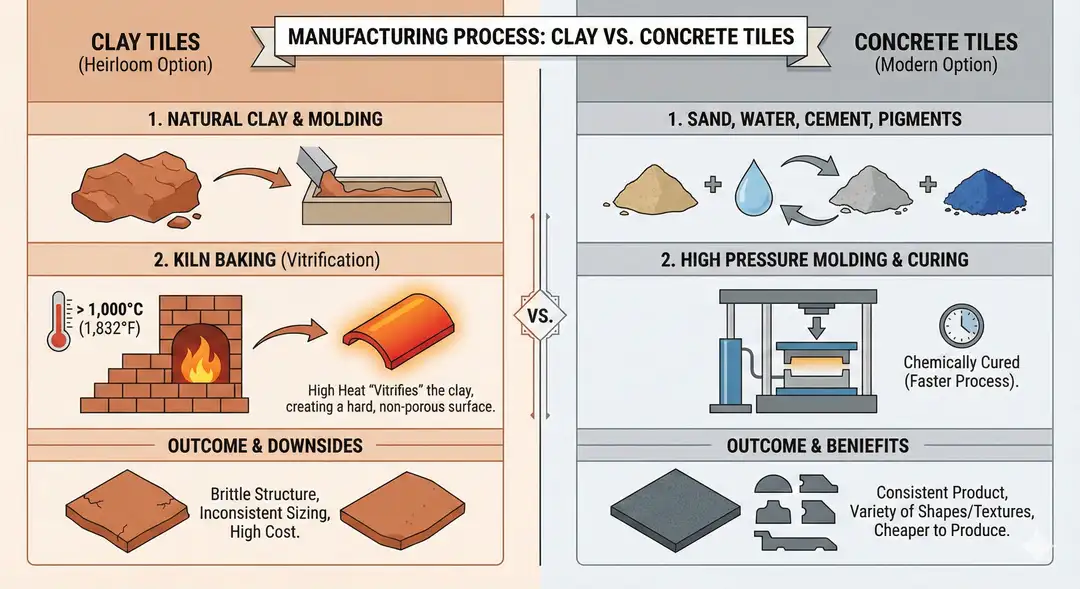
Clay
Clay tiles are the “heirloom” or “legacy” option. They are made from natural clay that is molded and baked in kilns at temperatures exceeding 1,000° C (1,832° F). The high heat ‘vitrifies’ the clay (meaning it makes it more glass-like), locking in the color and creating a hard, non-porous surface.
This ancient process comes with some downsides, though. The most glaring is the price tag (more on that below), but what you might not know is that the baking process also makes its structure more brittle and its sizing inconsistent due to the somewhat random nature of a kiln fire.
Concrete
Conversely, concrete tiles are a totally different beast. Like all concrete products, they are made from a mixture of sand, water, and oxide pigments.
Instead of being baked over a fire, they are molded under high pressure and chemically cured. This process is faster, produces a more consistent product, and allows for a wider variety of shapes and textures.
Longevity / Durability
Lifespan
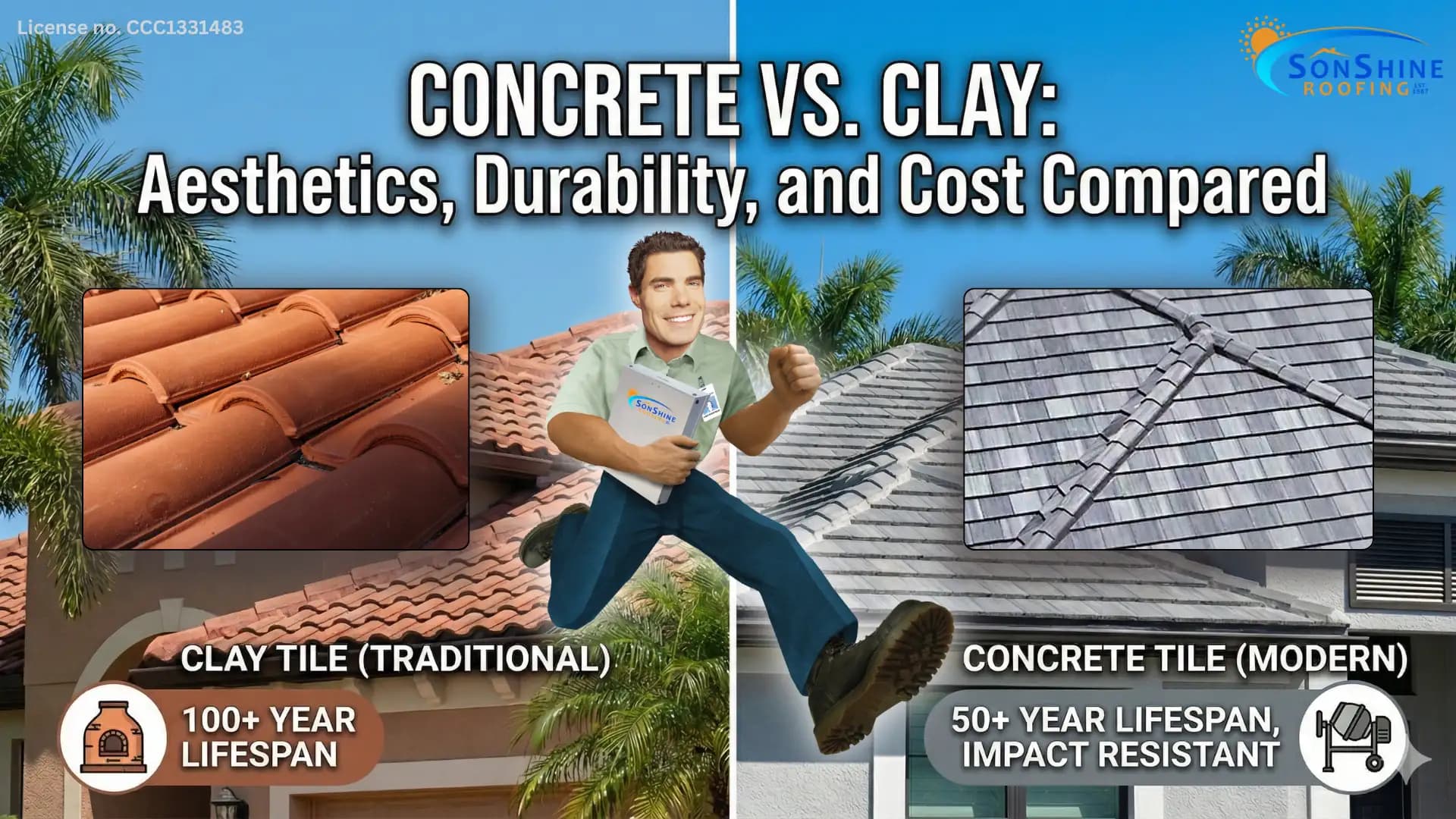
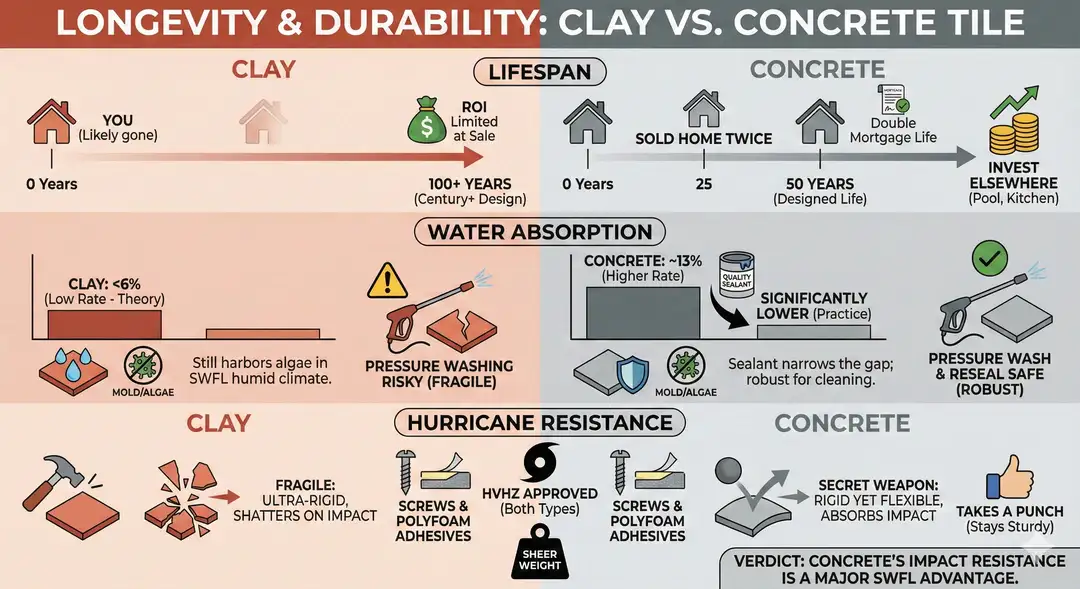
Let’s be real: your roof doesn’t need to last 100 years. Even though clay tile roofs are designed to last a century or longer, are you going to be around to bask in its glory? Probably not, and having a clay roof at the time you sell your home won’t net you much of the difference either.
On the other hand, while it’s true that concrete tile roofs are only designed last around 50 years or so, this is nearly double the lifespan of a typical mortgage anyway. You’ll have sold the home twice-over by the time the roof needs a full replacement. Paying for a 100-year roof when you only need 50 years of performance is often money that could be better invested into a pool or kitchen renovation instead.
Water Absorption
At first glance, clay seems to be the clear winner here. Its water absorption rate is much lower (<6%) than that of concrete (roughly 13%). In theory, this helps combat mold and algae growth. In practice, however, it’s not as cut and dry.
A quality sealant for concrete tiles can narrow this gap significantly. In our humid Southwest Florida climate, everything, including clay, gets waterlogged and will eventually harbor algae and mold if given enough time. The difference here is that concrete is robust enough to be pressure washed and resealed without shattering every second tile you step on.
Hurricane Resistance
This is a non-negotiable for Florida homeowners with tile roofs. Lucky for us, we’re covered with either choice when it comes to wind uplift resistance. Both clay and concrete are approved for High Velocity Hurricane Zones (HVHZ), and they’re installed with a combination of screws and polyfoam adhesives. This, in addition to their sheer weight, keeps them in place when facing 150mph+ winds.
But, concrete has a secret weapon: impact resistance. Remember, clay is fragile. Its ultra-rigid structure doesn’t flex, so it can’t absorb impact forces very well. In other words, it shatters. Concrete, on the other hand, shrugs off most impacts. Since it was designed to both be rigid and somewhat flexible, it can better absorb forces while remaining sturdily in place. Personally, as a Floridian myself, I’d rather have a roof that can take a punch or three. I’ve seen with my own eyes what 150 mph+ winds can do, and it’s not pretty.
Aesthetics
Clay
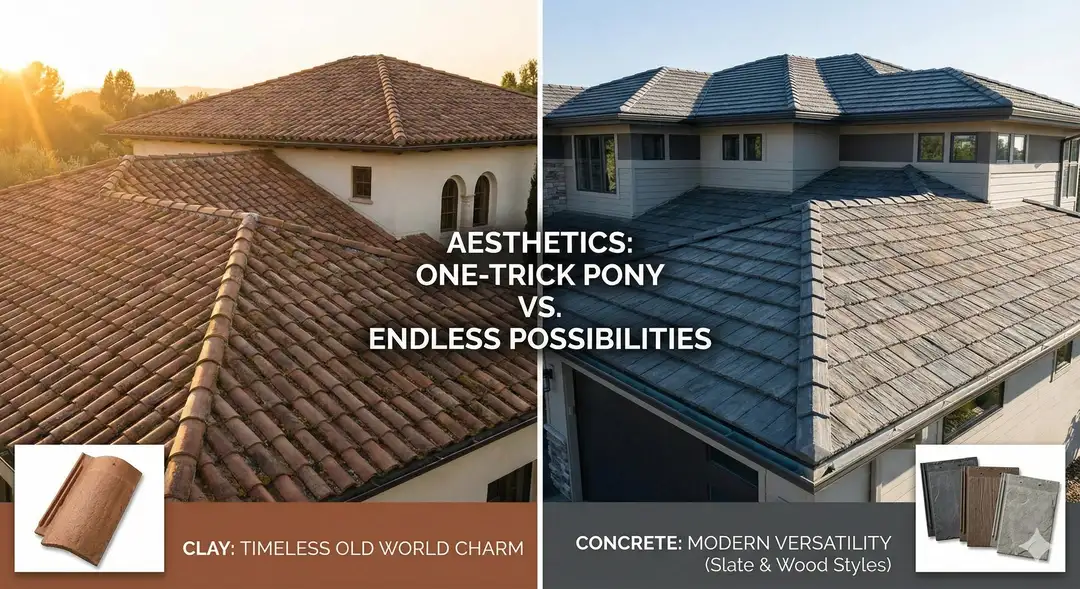
There is absolutely no denying that clay is a gorgeous building material. It possesses that distinct Terra Cotta look that never fades. It offers a very specific “Old World” Mediterranean style, which is great if you’re interested in replicating a 17th-century Spanish villa.
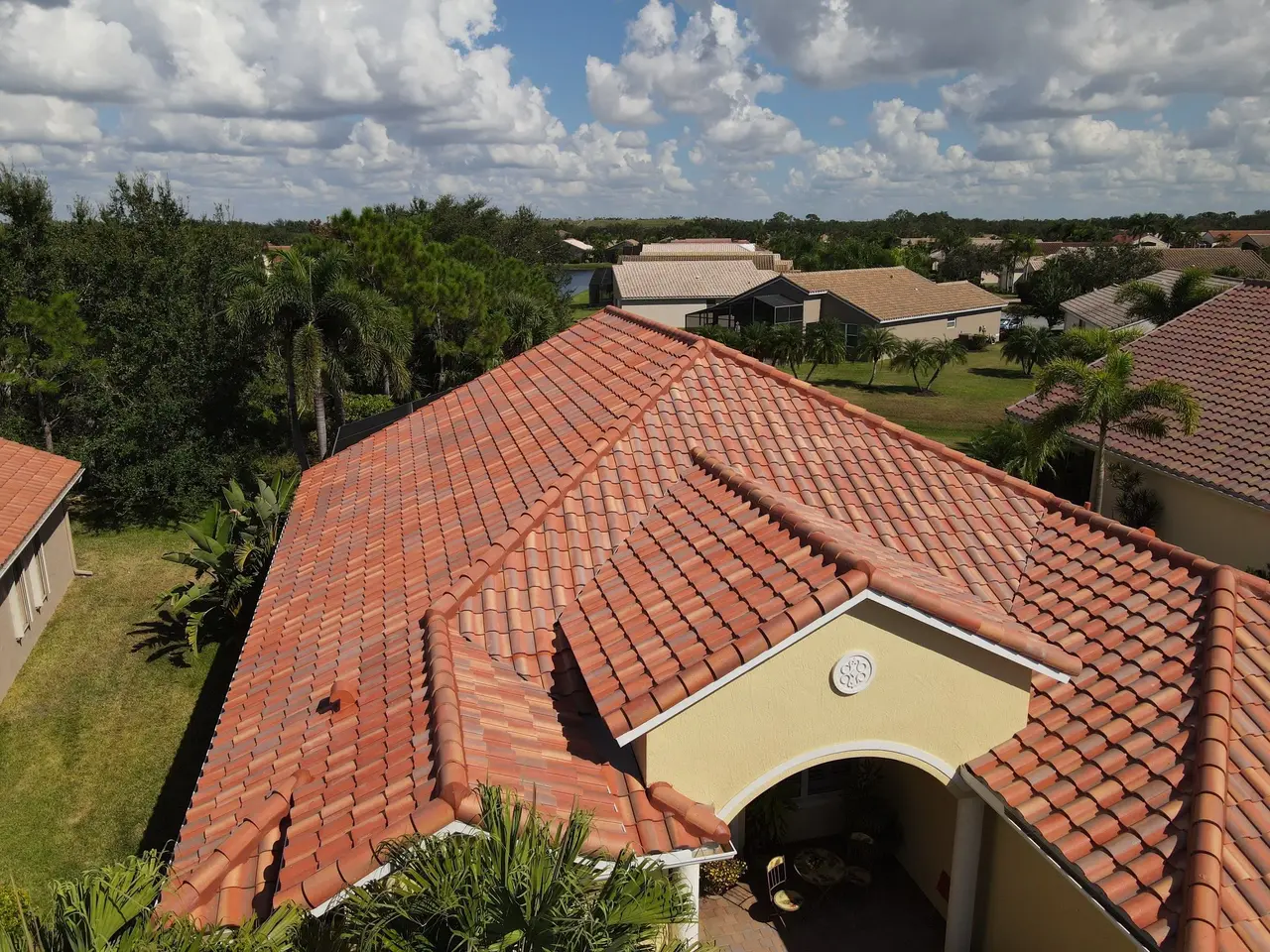
For everyone else though, it’s a one-trick pony.
Concrete
These days, we’re spoiled. Concrete tiles are no longer just dull, gray slabs. Unlike clay, modern concrete can mimic, wood shake, slate, ceramic, and even split stone. The manufacturing process allows for making crisp lines, detailed textures, and modern profiles that clay just can’t do. For example, I bet you didn’t notice that the “clay” roof above is a concrete roof in disguise!
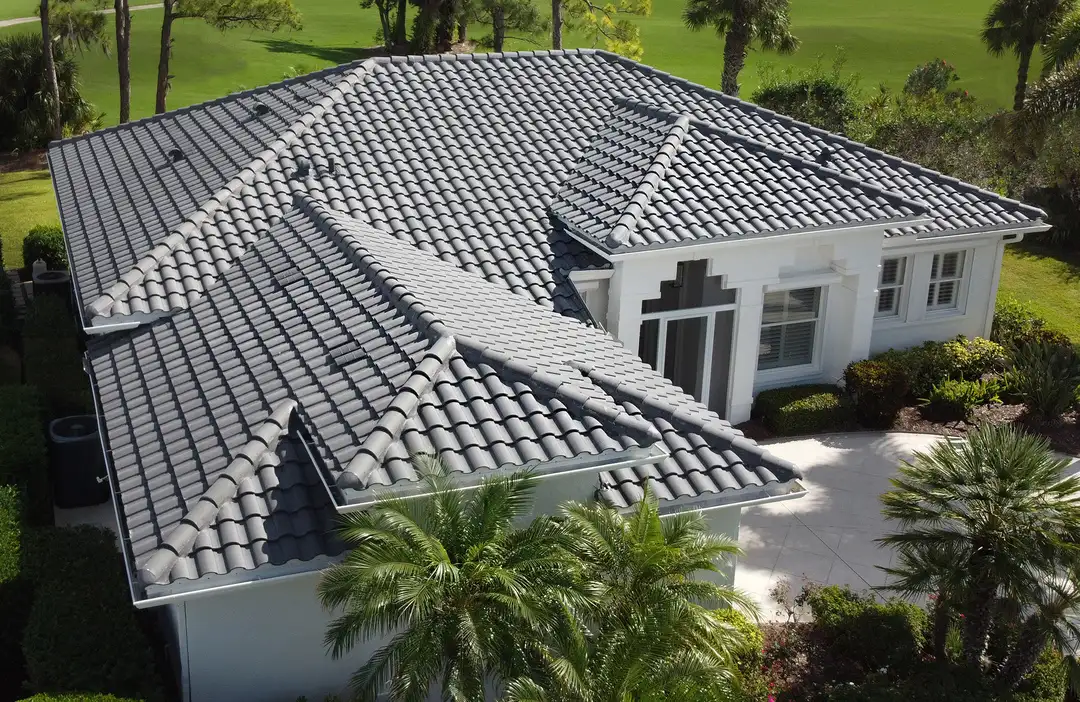
As alluded to before, it’s inevitable that concrete experiences some fading after 15-20 years as the pigment on the surface wears down. Sealants help, but they aren’t impervious to time. Keep in mind though that this is purely cosmetic. It doesn’t affect the roof’s performance in the slightest.
Cost
This is what ultimately moves the needle for most. Let’s talk hard numbers.
Upfront Cost
Since clay is much more “premium” and niche, you’re looking at 30% to 50% higher material costs straight away.
- Clay: ~$15.00 to $25.00+ per square foot
- For a typical 2,500 sq. ft. roof, that’s anywhere between ~$37,500 to $62,500+ total.
- Concrete: ~$10.00 to $19.00 per square foot
- The same size roof now costs you significantly less, clocking in at ~$25,000 to $47,500 total.
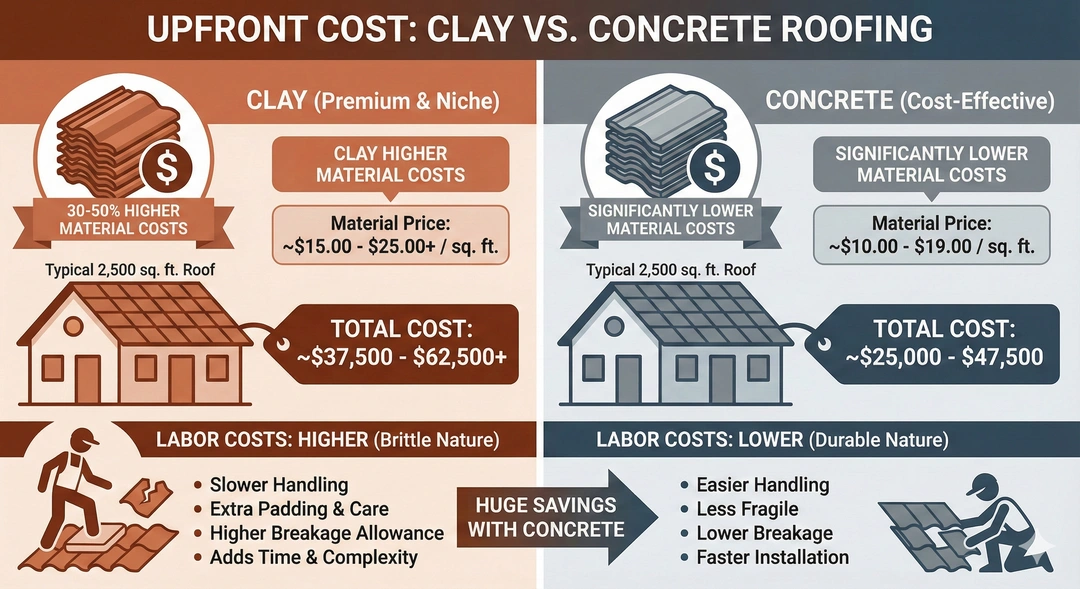
But it’s not just the material cost that’s higher; it’s also the labor cost. The brittle nature of clay is a nightmare when handling it in the field. Crews have to move slower, pad every step, and order extra material for breakage allowance. All of this adds time and complexity to the job. Conversely, concrete is much more forgiving in this regard. It’s easier to install, way less fragile, and can be walked on (carefully) without padding.
Maintenance Costs
On paper, clay is the “low maintenance” option. After all, its superior longevity means that you’ll be touching it less, and light repairs are few and far between. But there are some caveats to this.
For example, if you end up needing to fix a flashing or replace a broken tile, good luck. Finding a perfect color match for a 20-year-old clay tile roof is next to impossible since no two batches from the kiln are identical. Even if you find the match, expect to pay 20-30% more for simple repair labor simply because neighboring tiles tend to break when prying out the bad one.
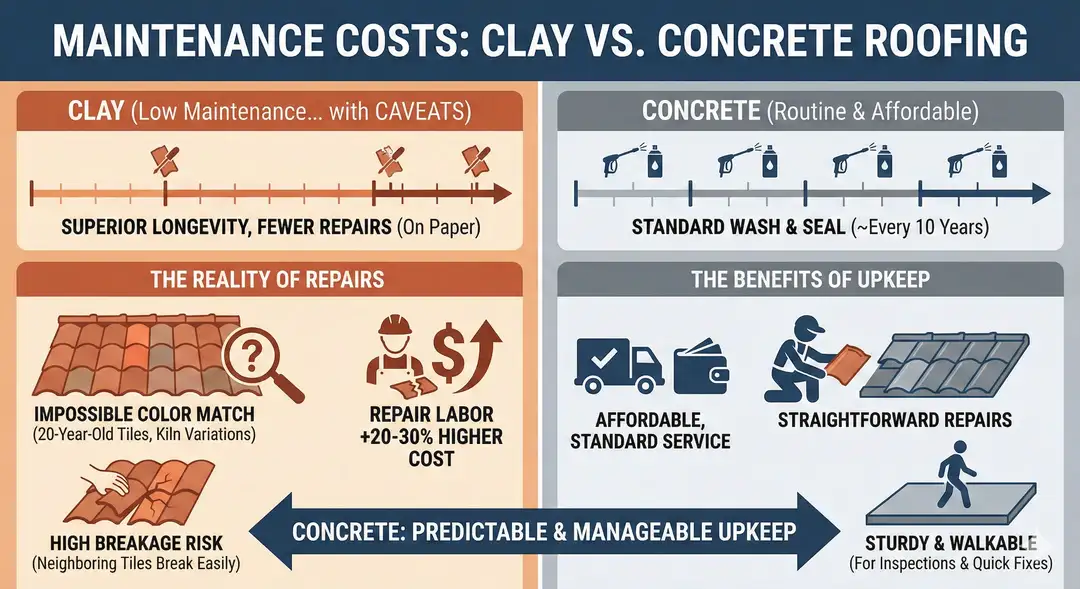
Concrete, on the other hand, requires a wash and seal every 10 years or so to keep it fresh, but this is a standard, affordable service. Repairs are straightforward, and it’s sturdy enough to be (carefully) walked on for inspections and quick repairs.
Resale Value
Clay adds “prestige” value, sure. But unless you are in an ultra-luxury market like Port Royal or Casey Key, you rarely get that money back. For 95% of Florida homes, a concrete tile roof signals quality just as loudly as clay, but leaves you with $15,000 extra in your pocket when you close on the house.
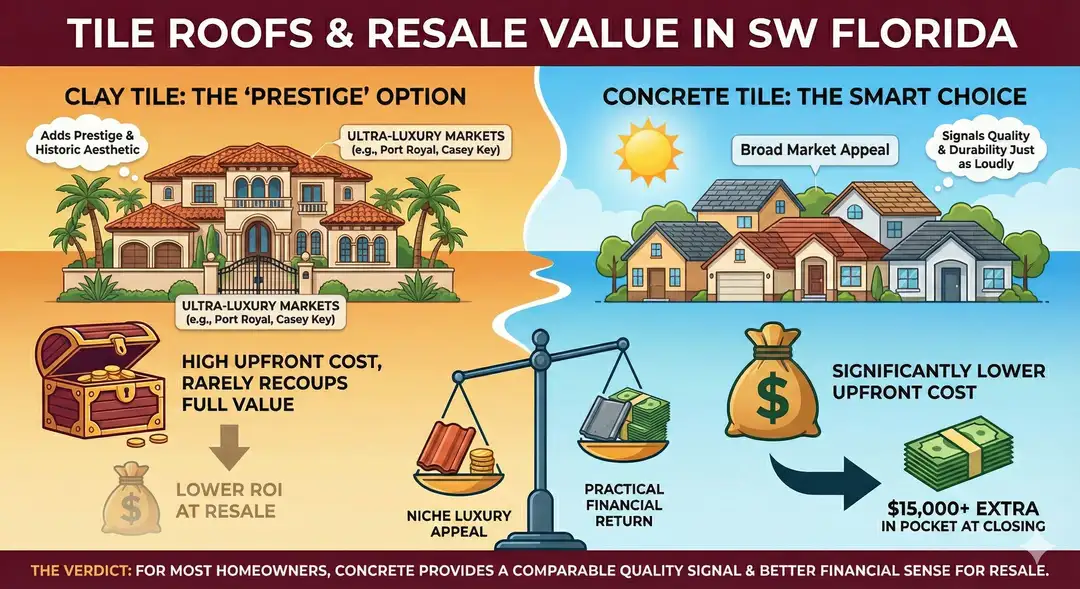
The Verdict
If you are building a custom estate and demand that specific historic terra cotta patina, then clay is a fine choice. Sure, it’s expensive, but if you have expensive taste and the pocketbook to match, there’s nothing inherently wrong with that.
But, for the rest of us who value aesthetics and practicality, concrete is the winner, without a doubt.
It handles the abuse of Florida weather, resists impact better than clay, and provides that beautiful, tiled aesthetic for a fraction of the cost. Why break the bank for a 100-year clay roof when a 50-year concrete roof does the job just as well (if not better), looks stunning, and leaves you with enough cash left over to actually enjoy living under it? The choice is clear in my book.
Ready to Get Started?
If you’re in the market for a new tile roof, or just want to learn more about your options, get in touch with the best roofing company in the Sarasota Area: SonShine Roofing. Fill out the form online or give us a call at (941) 866-4320.
Since 1987, we’ve got you covered.