A Joint Publication by SonShine Roofing and Southern Standards Landscaping Services
In Southwest Florida, heavy rain is not rare. It is part of the deal.
Between summer downpours, tropical systems, and hurricane season, homes in Sarasota get hit with intense bursts of water over short periods of time. Local agencies and water-management organizations treat stormwater seriously for a reason: runoff from roofs and other hard surfaces can create flooding, erosion, and water-quality problems if it is not controlled properly.
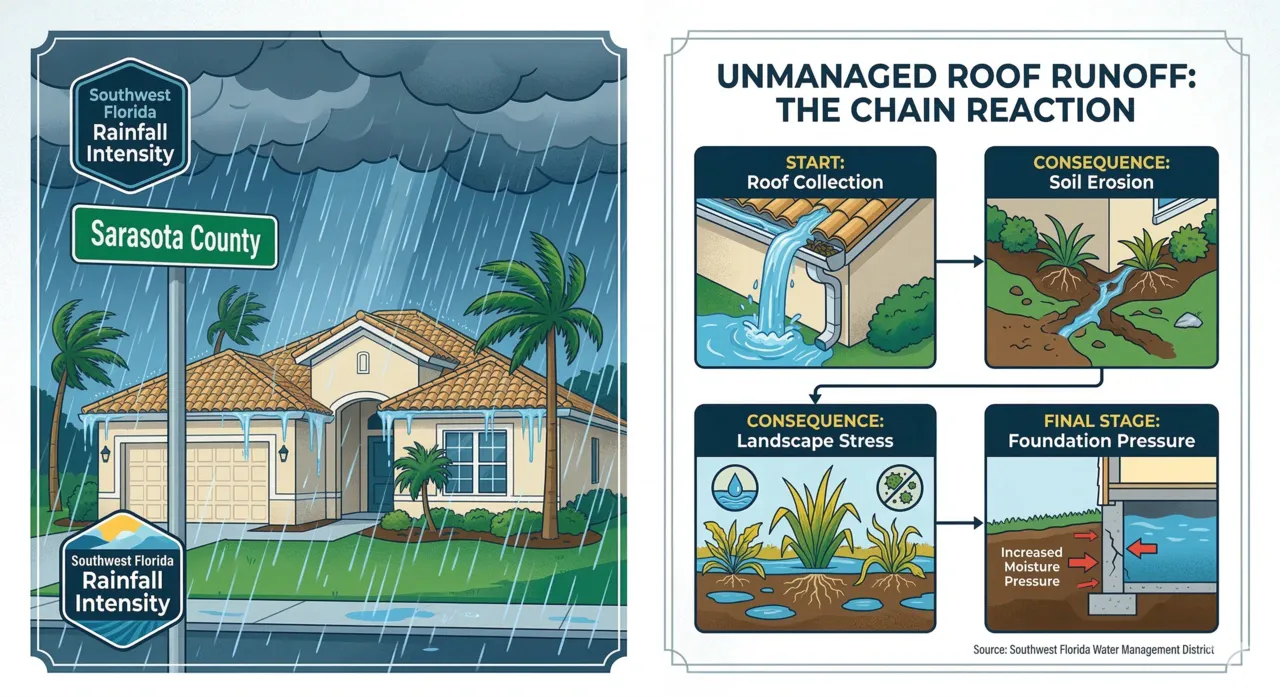
For homeowners, that same problem shows up a little closer to home. When roof runoff is not captured and redirected properly, it can wash out topsoil, stress or kill plants, create standing water, and increase moisture pressure around the foundation. It may look like “just a drainage issue,” but in reality it is a chain reaction that starts at the roofline and ends in the soil around your home.
Source: Southwest Florida Water Management District
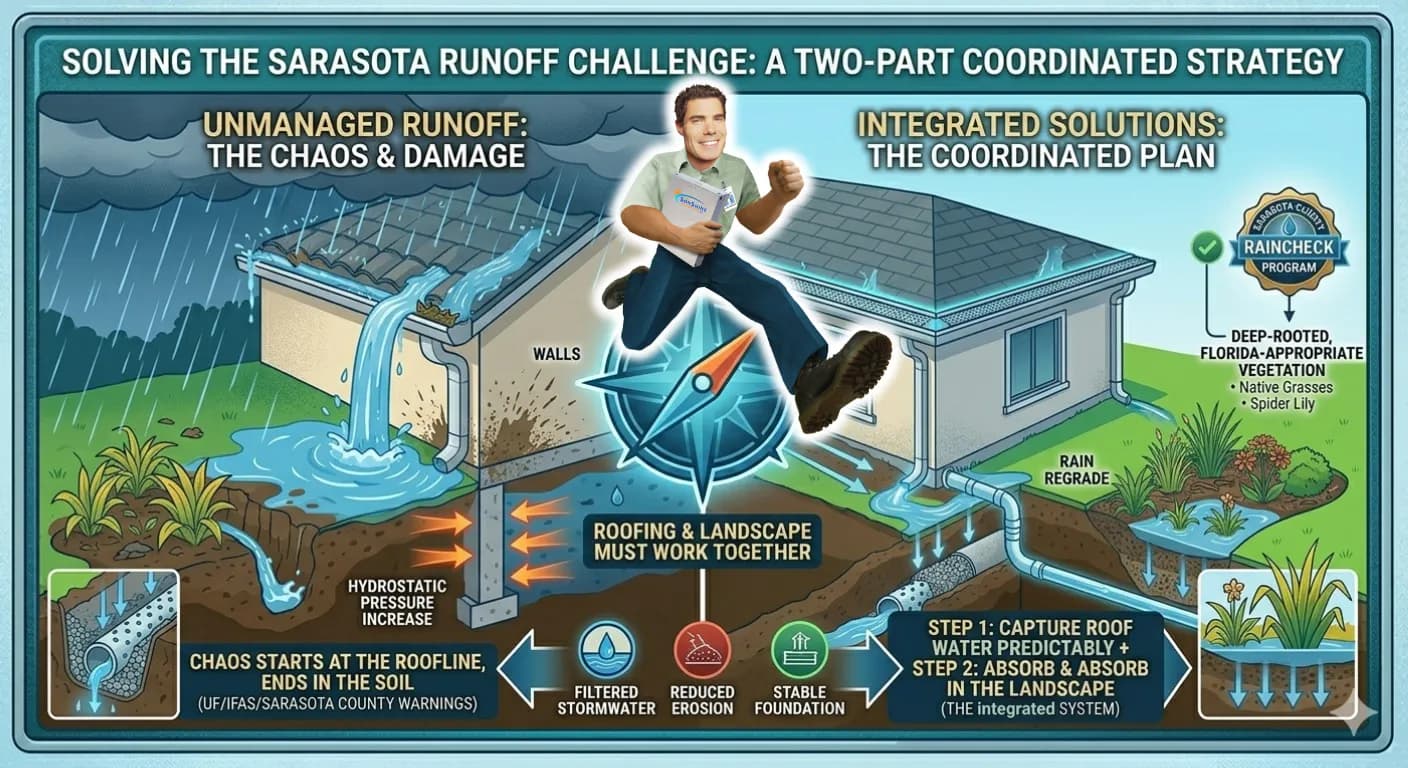
That is why solving runoff problems usually takes more than one trade. The roof controls where the water begins. The landscape and drainage system control where that water goes next. If either side fails, the rest of the property gets dragged into the chaos like an unwilling extra in a disaster movie.
Your Roof Collects More Water Than Most Homeowners Realize
A roof is not just a lid on your house. During a storm, it becomes a large impermeable catchment surface that gathers rain and concentrates it into specific discharge points.
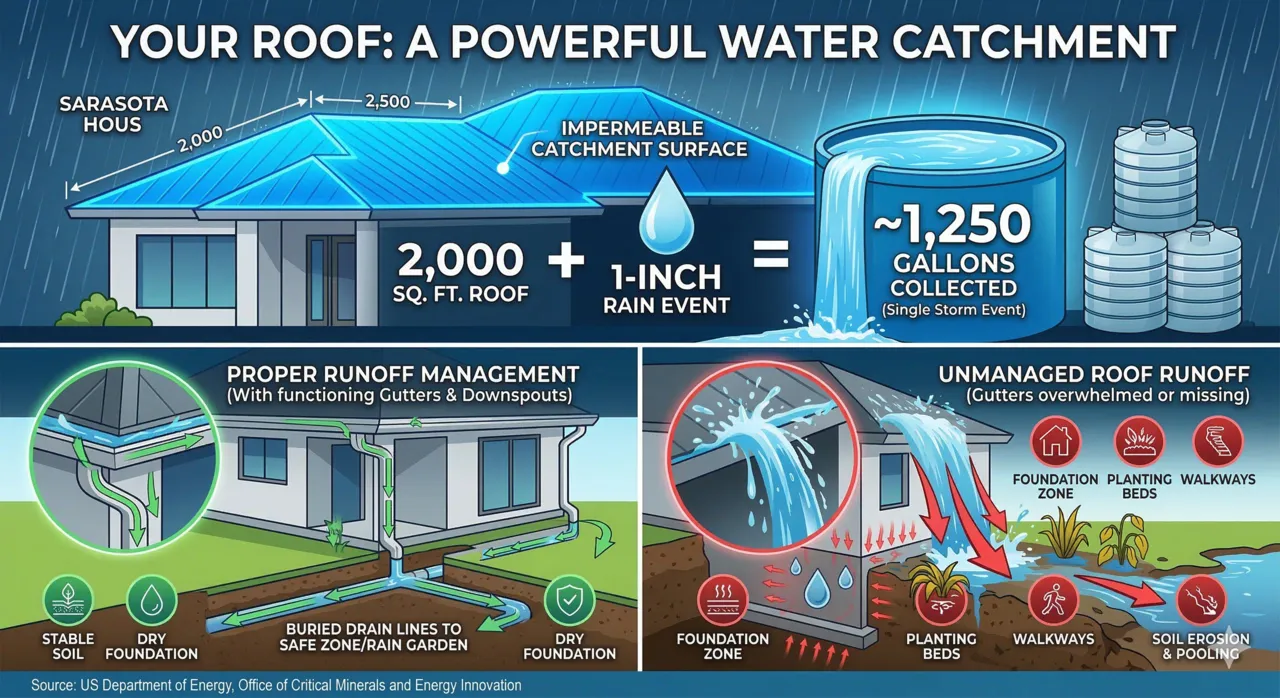
A 2,000-square-foot roof can shed about 1,250 gallons of water in a one-inch rain event. In Sarasota, where strong storms can dump a lot of rain quickly, that volume becomes a real management issue fast. When runoff is not directed into a functioning gutter and drainage system, it tends to hit the ground with force in the exact places you least want it: near the foundation, planting beds, walkways, and low spots in the yard.
Proper gutters and downspouts help by collecting roof runoff and sending it away from the house. Building-science guidance specifically notes that gutters and downspouts reduce the chance of saturating soil near foundations.
Source: US Department of Energy, Office of Critical Minerals and Energy Innovation
What Happens When the Gutter System Fails
Runoff problems do not always begin with dramatic failure. Sometimes the issue is more boring, which is rude but true.
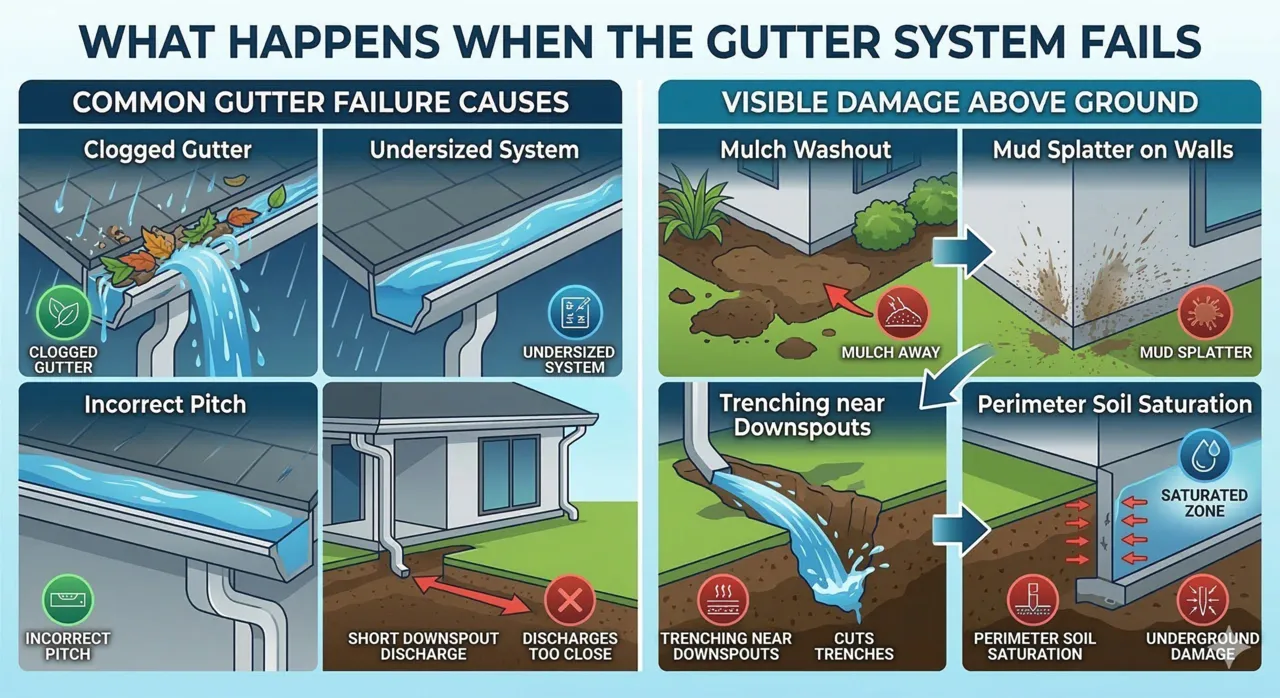
A gutter may be clogged. A downspout may discharge too close to the home. The system may be undersized for the roof area. The pitch may be off. Water may be spilling over one edge over and over again. In a region with frequent heavy rain, even small design or maintenance issues can create repeated overflow and concentrated discharge.
Once that happens, water starts carving out predictable paths. It washes mulch away, splashes mud onto walls, cuts trenches near downspouts, and saturates the same perimeter zones again and again. Over time, the visible symptoms above ground can line up with less visible roof runoff damage below it.
How Roof Runoff Damage Can Threaten Your Foundation
This is the part homeowners often do not see until the symptoms get expensive.
When water collects around the base of a house, it saturates the surrounding soil. That increases pressure and moisture exposure around slabs, stem walls, and other foundation components. Guidance from building-science and stormwater sources consistently stresses the importance of moving water away from the structure to prevent soil saturation and related foundation problems.
Source: Sarasota County Stormwater Environmental Utility
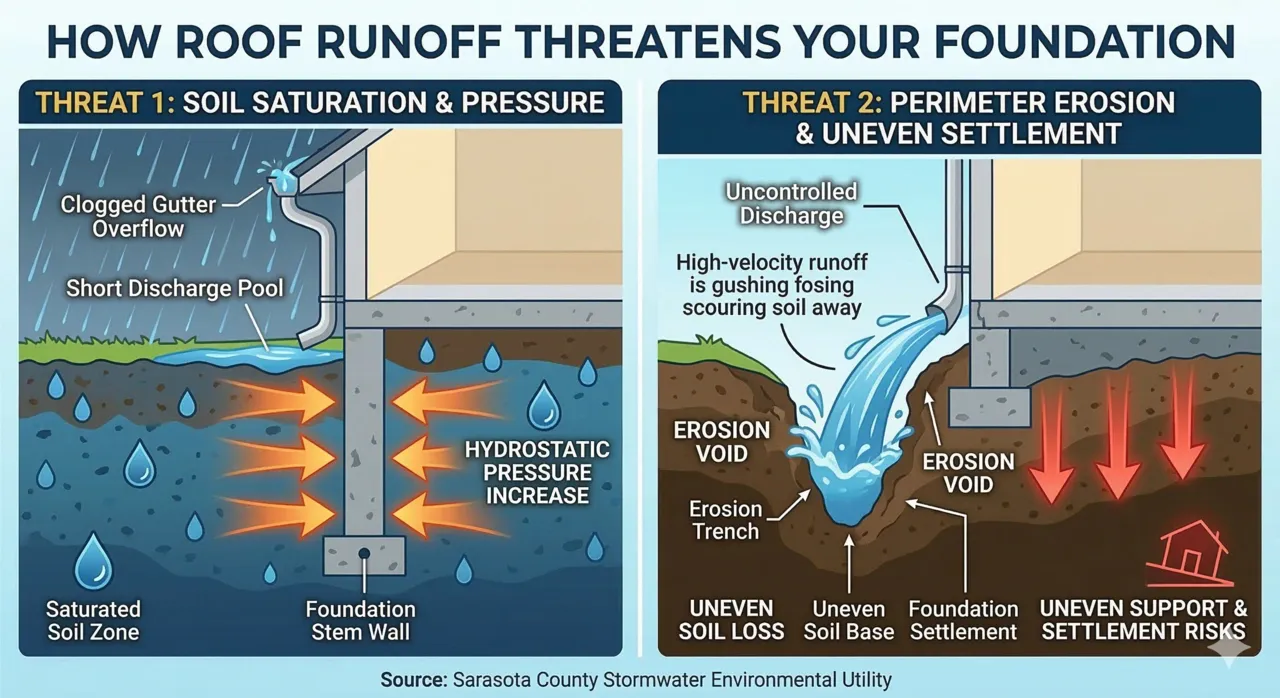
Another problem is erosion beneath discharge areas. If runoff repeatedly scours soil away from the perimeter, the support conditions around parts of the home can become less uniform. That uneven soil loss can contribute to settlement-related problems over time, especially when combined with repeated wet-dry cycles and poor grading.
Put less politely, water is patient, gravity is relentless, and concrete is not magic.
Why Your Yard and Plants Start Losing the Fight
The landscape usually feels the runoff damage sooner.
Fast-moving runoff strips away topsoil, and that matters more than people think. Healthy topsoil is where a lot of the biological action happens. It holds organic matter, nutrients, and the structure that helps plants establish roots. Florida-Friendly Landscaping guidance specifically notes that healthy landscape practices help stabilize soil, prevent erosion, filter pollutants, and reduce harmful runoff.
Source: University of Florida, Institute of Food and Agricultural Sciences
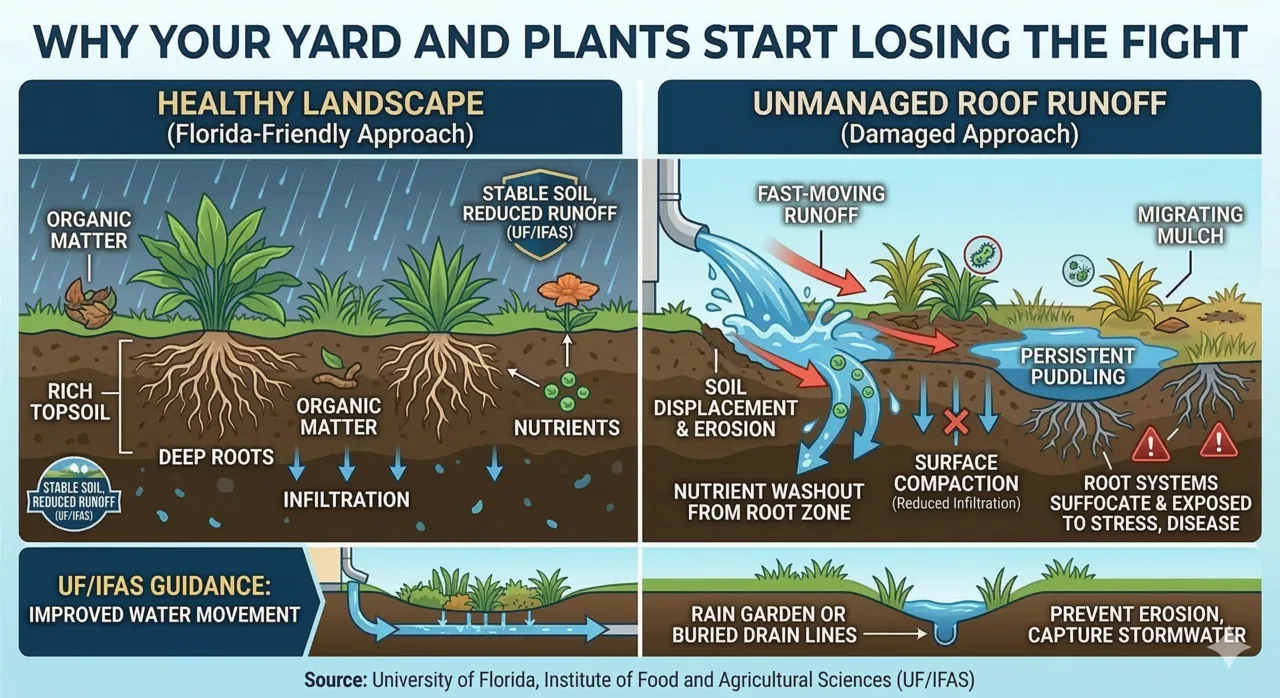
When runoff repeatedly pounds the same areas, a few things happen at once:
- Soil gets displaced.
- Nutrients get washed out of the root zone.
- The surface can compact, which reduces infiltration.
- Low areas hold water longer than they should.
- Root systems are exposed to stress, suffocation, and disease.
UF/IFAS materials on rain gardens and runoff reduction emphasize that properly designed drainage features can help prevent erosion, capture stormwater, and improve how water moves through the landscape.
That means a yard with runoff problems may show up as dead turf, yellowing plants, fungal issues, bare spots, persistent puddling, or mulch that seems to migrate every time Florida remembers it is Florida.
Why Sarasota Properties Are Especially Vulnerable
Southwest Florida has a few traits that make runoff problems nastier.
One is rainfall intensity. Stormwater agencies for this region specifically emphasize the importance of drainage systems because stormwater runoff is a major issue in local watershed protection and flood mitigation.
Source: Sarasota County Stormwater Environmental Utility
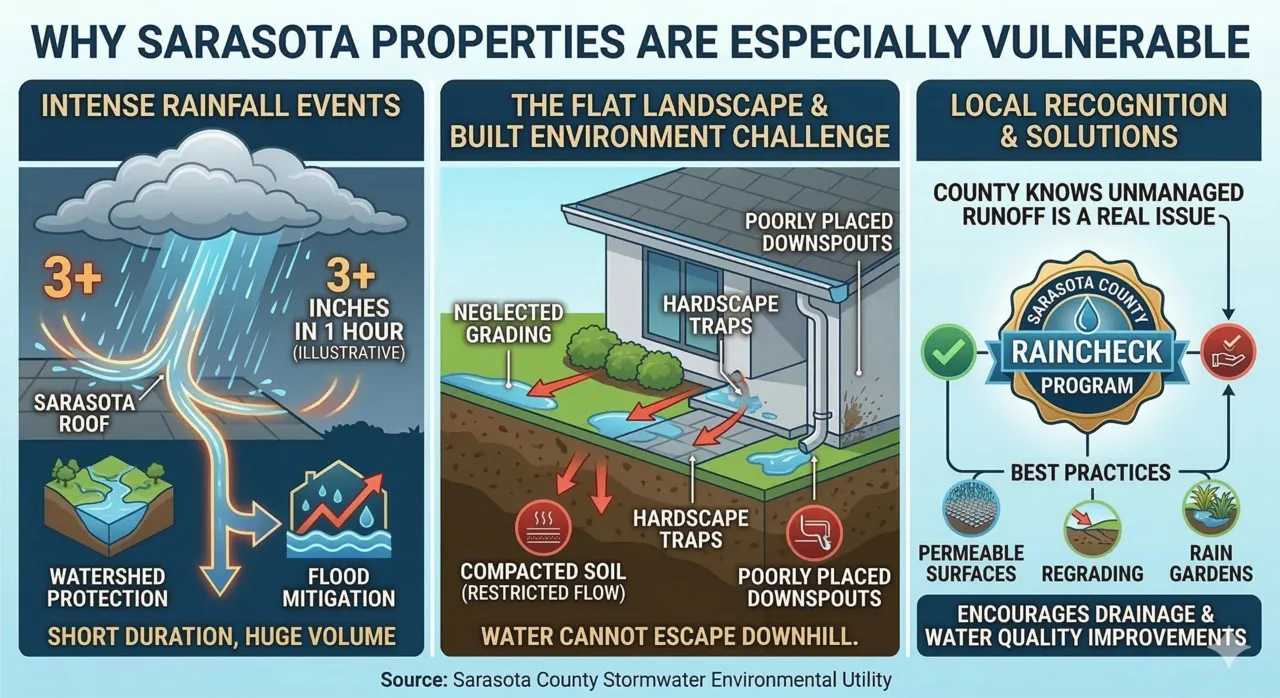
Another is landscape design reality. Many residential lots are relatively flat. That means water does not always have a clean downhill escape route. Add compacted soil, hardscape, poorly placed downspouts, or neglected grading, and runoff starts collecting where it should not.
Sarasota County also actively promotes small-scale stormwater best practices for homeowners through its RainCheck rebate program, which exists specifically to encourage drainage and water-quality improvements on residential properties. That tells you this is not some fringe homeowner obsession. The county knows unmanaged runoff is a real issue.
Source: Sarasota County Stormwater Environmental Utility
The Best Fix Is a Two-Part Strategy
The most effective solution is usually not “more gutter” or “more landscaping” by itself.
It is an integrated strategy:
First, capture and direct the water properly at the roofline.
Then, receive, move, or absorb that water safely in the landscape.
That is the whole game.
Step 1: Fix the Roof Runoff Path
At the roofing level, the goal is to control water at its highest point of collection.
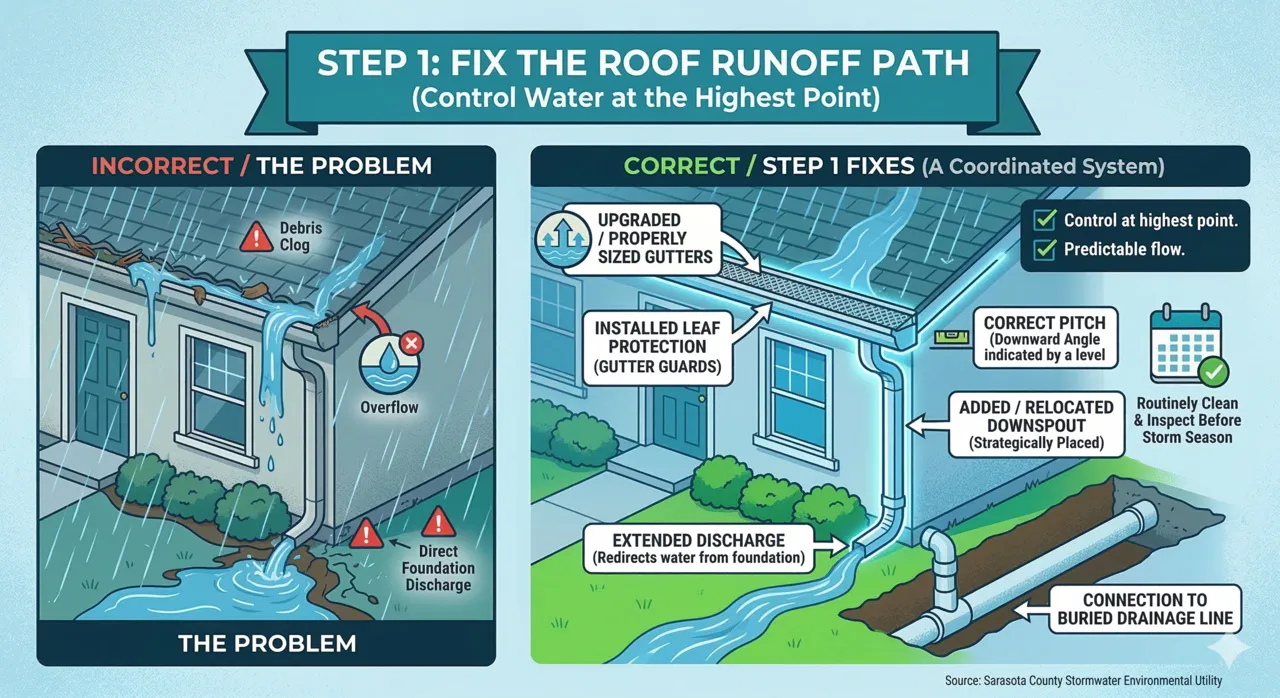
That may include:
- replacing failing or undersized gutters
- improving gutter pitch
- adding or relocating downspouts
- extending discharge farther from the home
- connecting downspouts to buried drainage lines
- installing leaf protection where debris is causing overflow
- routinely cleaning and inspecting the system before storm season
The point is not just to get water off the roof. Gravity already has that covered. The point is to get it off the roof predictably and safely.
Step 2: Build a Landscape That Can Handle the Water
Once runoff leaves the roof, the yard needs to be prepared to receive it.
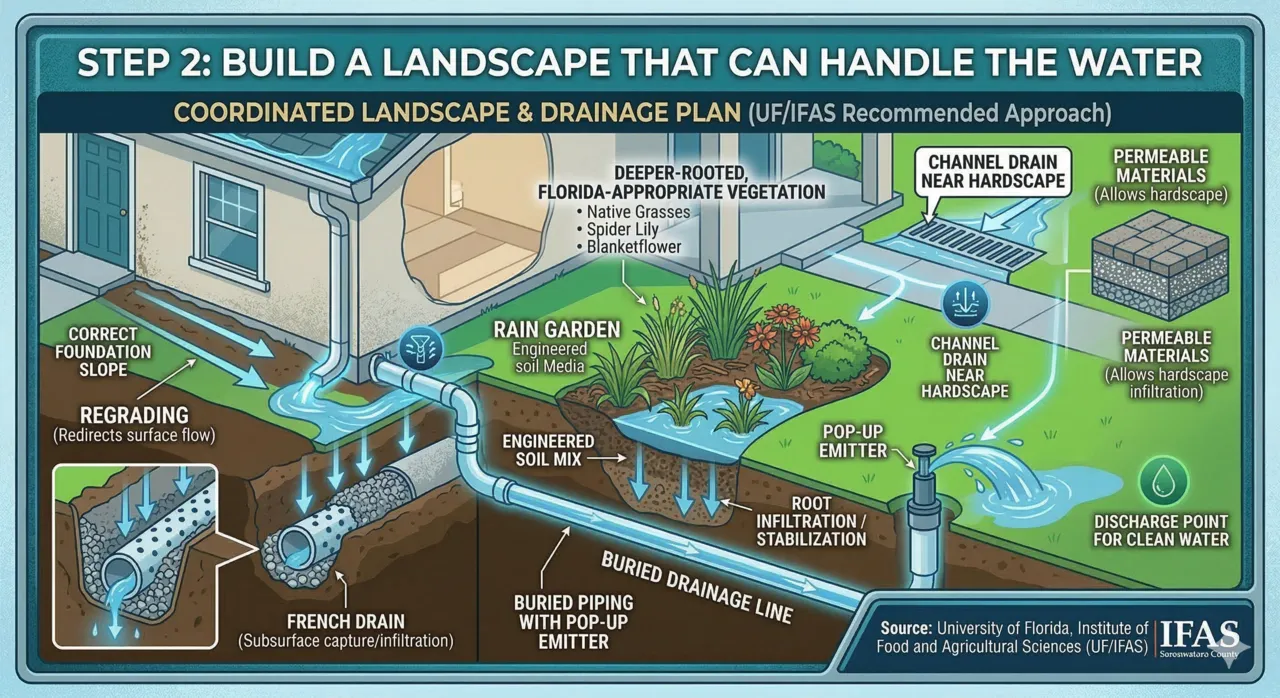
Depending on the property, that may involve:
- regrading around the foundation
- installing French drains
- adding channel drains near hardscape
- using buried piping with pop-up emitters
- building rain gardens in appropriate areas
- using permeable materials where runoff is collecting
- planting deeper-rooted, Florida-appropriate vegetation to stabilize soil
UF/IFAS recommends rain gardens and other Florida-Friendly approaches to reduce stormwater runoff, and Sarasota-area Florida-Friendly Landscaping resources specifically note that good landscape design helps prevent erosion and filter runoff before it becomes a larger problem.
Source: University of Florida, Institute of Food and Agricultural Sciences
The key is to make sure those improvements are coordinated with the roof drainage plan. A pop-up emitter in the wrong place can just relocate the mess. A French drain without fixing the overflowing gutter feeding it is just a very polite surrender.
Signs You May Already Have a Roof Runoff Problem
Your roof might already have runoff issues.
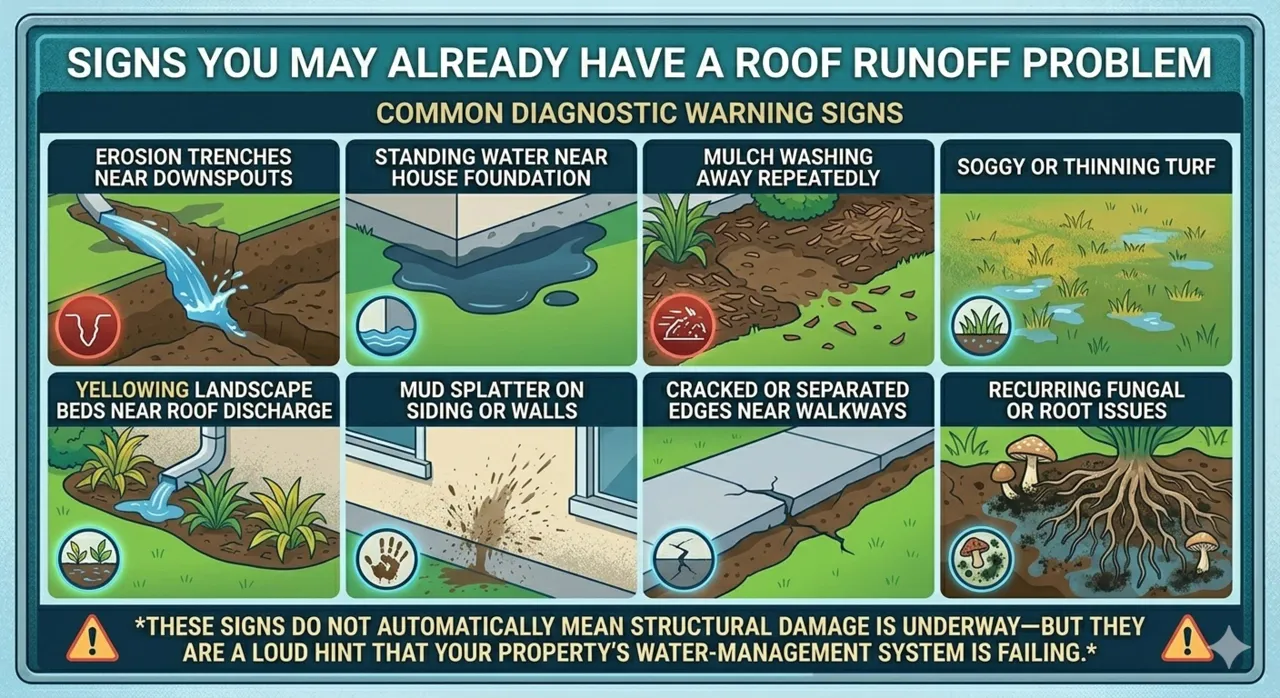
Some common warning signs include:
- trenches or erosion channels near downspouts
- standing water near the house after rain
- mulch washing away repeatedly
- soggy or thinning turf
- yellowing landscape beds near roof discharge zones
- mud splatter on siding or walls
- cracked or separated edges near walkways, patios, or foundation beds
- recurring fungal or root issues in overwatered zones
None of these signs automatically means structural damage is underway. But together, they are a loud hint that your property’s water-management system is not behaving itself.
The Bottom Line
In Sarasota and across Southwest Florida, roof runoff damage is not just a maintenance annoyance. It is a force multiplier.
When it is managed properly, rainwater moves off the roof, away from the foundation, and through the landscape in a controlled way. When it is not, the same water can erode soil, weaken planting areas, create persistent drainage issues, and increase the stress placed on the structure itself.
Source: Southwest Florida Water Management District
That is why the smartest fix is usually a coordinated one. Roofing and drainage should work together, not operate like two contractors passing the blame baton back and forth.
If your home shows signs of washout, pooling, gutter overflow, or recurring wet areas near the foundation, it is worth evaluating the full runoff path from the roofline to the yard. That is where the real answer usually lives.
Want Professional Help?
Seeing washout, pooling, or gutter overflow around your Sarasota home? SonShine Roofing and Southern Standards Landscaping Services can help identify where the water is starting, where it is collecting, and what it will take to move it safely away from your home.
SonShine Roofing
Expert Residential Roofing Company in Sarasota, FL
Call: (941) 866-4320
Southern Standards Landscaping Services
Professional Residential Landscaping Company in Sarasota, FL
Call: (941) 822-1002
Sources
- Fairfax County Northern Virginia Soil and Water Conservation District. “Control Heavy Runoff: Solving Drainage and Erosion Problems.” Accessed March 10, 2026.
- Florida Department of Environmental Protection. “ERP Stormwater.” 2024. Accessed March 10, 2026.
- Schmitt Waterproofing. “The Connection Between Poor Drainage and Foundation Damage.” 2026. Accessed March 10, 2026.
- Southwest Florida Water Management District. “Stormwater Runoff.” WaterMatters.org. Accessed March 10, 2026.
- University of Rhode Island. “Reduce Soil Erosion.” URI HomeASyst. Accessed March 10, 2026.